
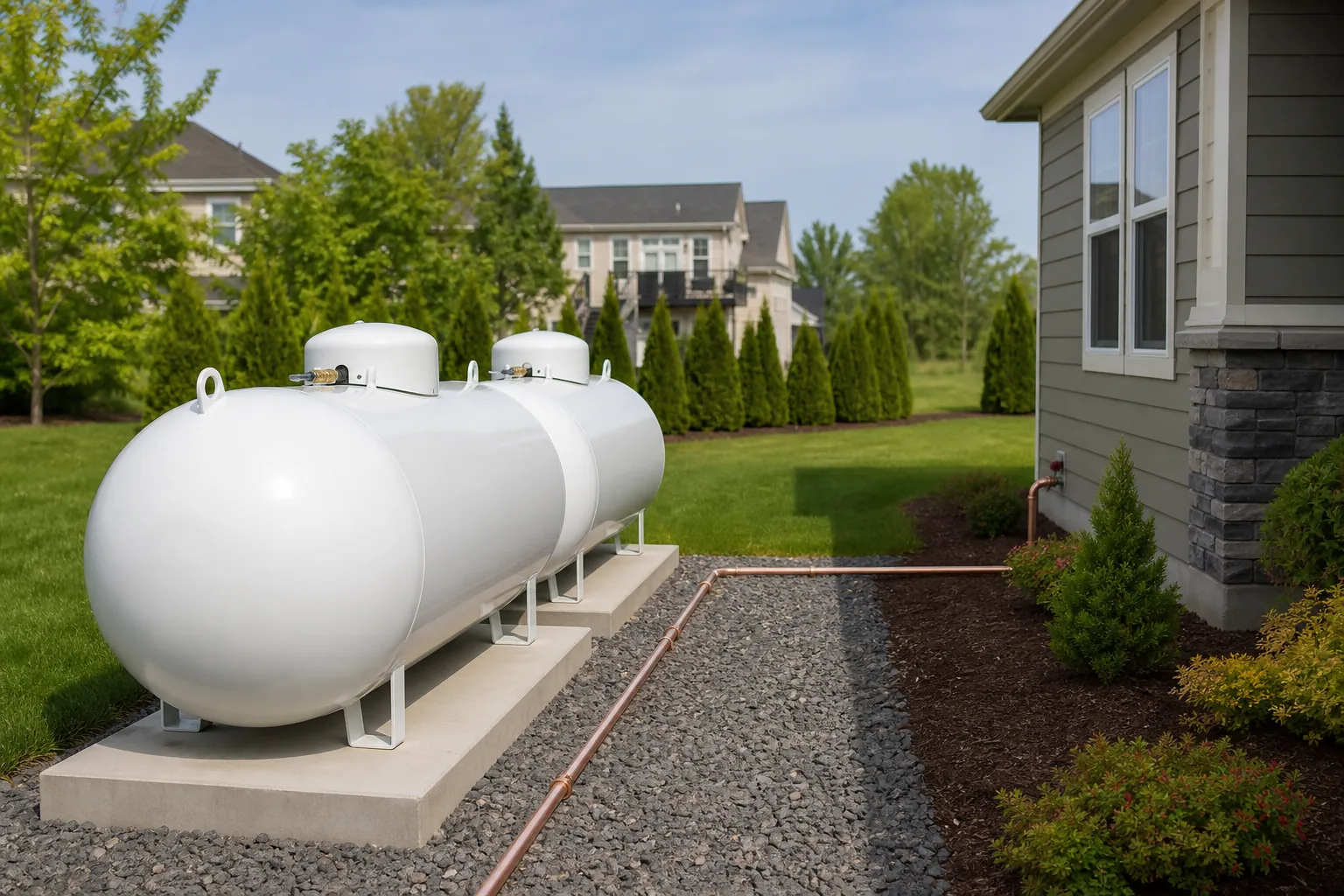
Start with what the property can actually support
A standby generator’s fuel choice depends on whether the home has a suitable natural-gas service, room and permission for a propane tank, delivery arrangements, local utility/fuel availability, and the generator’s exact fuel-specific ratings. A fuel type on a product listing does not prove that the service, meter, regulator, piping, or storage is adequate for the intended load.
Natural gas comes through a utility service where available; outages and restrictions can affect service, so ask the local utility about the property and do not assume availability during every emergency. Propane is stored on site and must be supplied, monitored, and replenished; tank capacity and fuel delivery are project-specific. A propane supplier and installer should confirm the tank and fuel-delivery design for the exact generator and climate.
Neither fuel is a universal cost or reliability winner. Use the household’s actual site conditions and a qualified professional’s assessment.
Exact model examples: output and fuel-use points
The following figures come from two specific 26 kW-class manufacturer documents. They illustrate why the fuel must be named; they are not predictions for other models or a recommendation for a home.
| Exact model | Standby output, LP | Standby output, natural gas | LP use at 50% load | Natural-gas use at 50% load |
|---|---|---|---|---|
| Generac G0073270 | 26 kW | 24 kW | 2.05 gal/hr | 182 ft³/hr |
| KOHLER 26RCA, single-phase configuration | 26 kW | 24 kW | 85 ft³/hr | 180 ft³/hr |
Consumption values are manufacturer test points at 50% load; the source documents use different volume units for LP. Actual use depends on output, load, fuel properties, ambient/site conditions, and equipment configuration. Do not rank these figures without checking the full model sheets and units.
Ask the installer to verify fuel capacity under load
- For natural gas: confirm utility service, meter and regulator capacity, permitted pressure, pipe size/route, and other appliances operating at the same time.
- For propane: confirm tank type/capacity, usable supply at the expected temperature, regulator and line requirements, refill access, and delivery arrangements.
- For either fuel: verify the exact model’s inlet-pressure range and installation requirements from the current manual; request written confirmation that the planned supply meets them.
- Ask about cold-weather accessories or fuel-system limitations only where the exact model manual and local conditions call for them.
Fuel piping, regulators, meters, and generator connections are not DIY tasks. The installation professional and relevant fuel provider/utility should coordinate the design and approvals.
Estimate operating cost with matching units and assumptions
For planning, use the exact model’s consumption rate at a manufacturer-stated load, multiply by the estimated operating time, then apply the current local cost for the same fuel unit. This is a scenario, not a forecast: actual generator load and run hours during an outage may differ substantially from the test point.
Do not use a generic “cost per hour,” mix gallons with cubic feet, or assume a fixed household load. Ask for a separate scenario for the loads you intend to back up, and record the fuel price date and units used. Include scheduled maintenance and local service costs separately.
Questions for your installer, utility, and fuel supplier
- Which exact model and fuel-specific output are included in the proposal?
- Has the fuel source been checked at the generator’s required load and pressure?
- What equipment or other appliances share the service, meter, tank, regulator, or piping?
- For propane, who owns the tank, monitors its level, and schedules deliveries during high demand?
- Which permits, inspections, site work, and utility coordination are included?
- What operating and maintenance instructions apply to the exact installed unit?
See the installation overview and cost guide for written-scope questions.